I mapped local readability cues inside a sealed Herculaneum scroll
Update, July 27, 2026: Follow-up inspection at the full 2.4 µm resolution showed that the highest-scoring pockets below were torn papyrus fragments, not coherent sheets. The survey successfully found local separability, but local separability did not identify segmentable surfaces. I have revised the interpretation throughout while preserving the original result.
I found that most of the 240 sampled PHerc1203 sites fail a local geometry gate used by the current virtual-unwrapping pipeline. A small number of locations initially scored comparably to known-readable regions in PHerc1667, a scroll that has been virtually unwrapped and read end-to-end. I have not read any letters. The follow-up result is narrower and more useful: this map shows where local sheet-like depth profiles occur, including false positives produced by torn fragments.
PHerc1203 is listed among the First Letters volumes, but the public eligibility list links its 9.362 µm volume; this work used the newer 2.403 µm scan. Whether that specific scan qualifies should be confirmed with the organizers before treating this as prize-targeted work.
The reason this matters is that the Vesuvius pipeline is not just an ink model. The usual path is:
segment the coiled sheet out of CT, flatten it, then run ink detection. The ink model only has a
chance if the flattened surface isolates one papyrus sheet in the 62-layer depth window it renders.
If the surface is sitting in a packed or overlapping region, the output becomes speckle. That is
exactly what the public auto_grown segmentation surfaces on PHerc1203 produce: no legible text, just
speckle.
So I treated this as a diagnostics problem before a modeling problem. I extended my earlier
readability gate into a CPU-only metric that can score candidate
sites before spending GPU time on rendering and ink detection. For each surface column, I peak-center
a 62-layer window on the brightest band along the local normal. A column is “readable-class” if two
conditions hold: occupancy is at most 0.5, and band-prominence is at least 0.55. A site’s
frac_readable is the fraction of its bright columns that pass both tests.
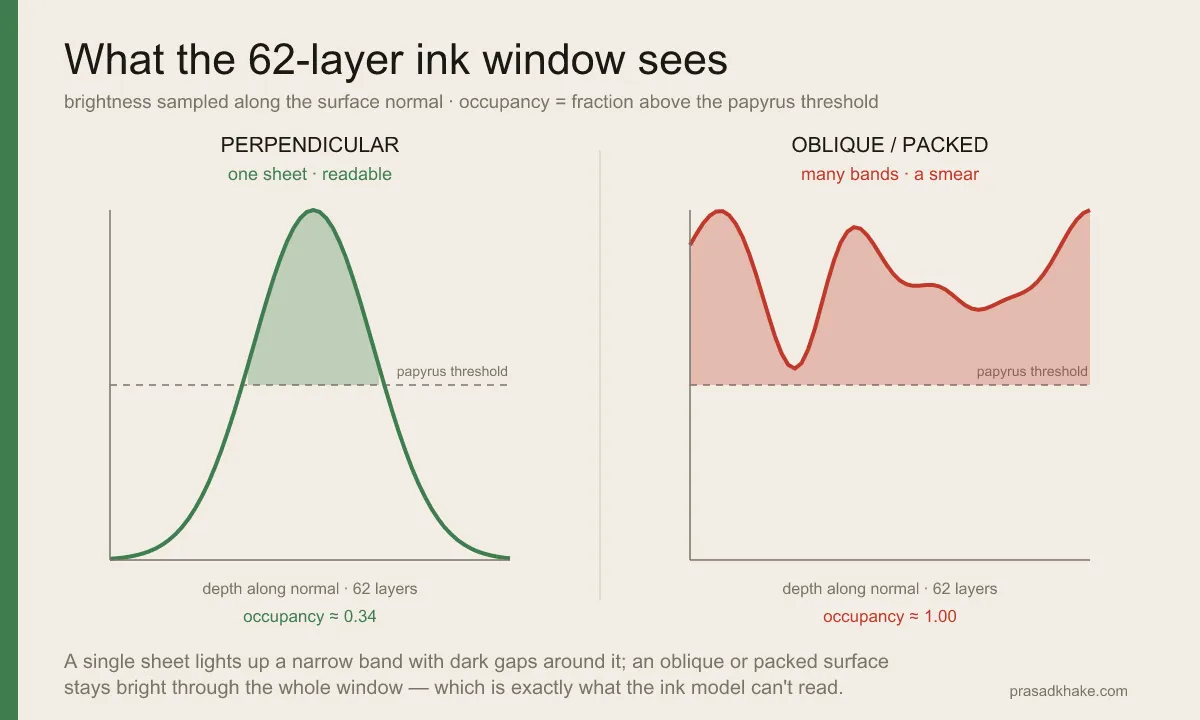
The metric in one picture. A column that isolates one sheet puts papyrus in a narrow, prominent band with dark gaps around it (readable-class). A column in packed or oblique material stays bright through the whole depth window — no isolable sheet for the ink model to read.
The important part was calibration. A metric like this is only useful as a ranking heuristic if it responds differently on known-readable surfaces and typical sealed-scroll samples. I ran the same metric, unchanged, on PHerc1667, which is already virtually unwrapped and readable end-to-end. Then I ran it on PHerc1203.
PHerc1667 lit up. Across 60 sites, the median frac_readable was 0.35, the p90 was 0.94, and 62% of
sites were at least 0.2. PHerc1203 did not. Across 240 stratified sealed-scroll sites, the median was
0.004, the p90 was 0.17, and only 10% of sites were at least 0.2. That is roughly a 90× median gap.
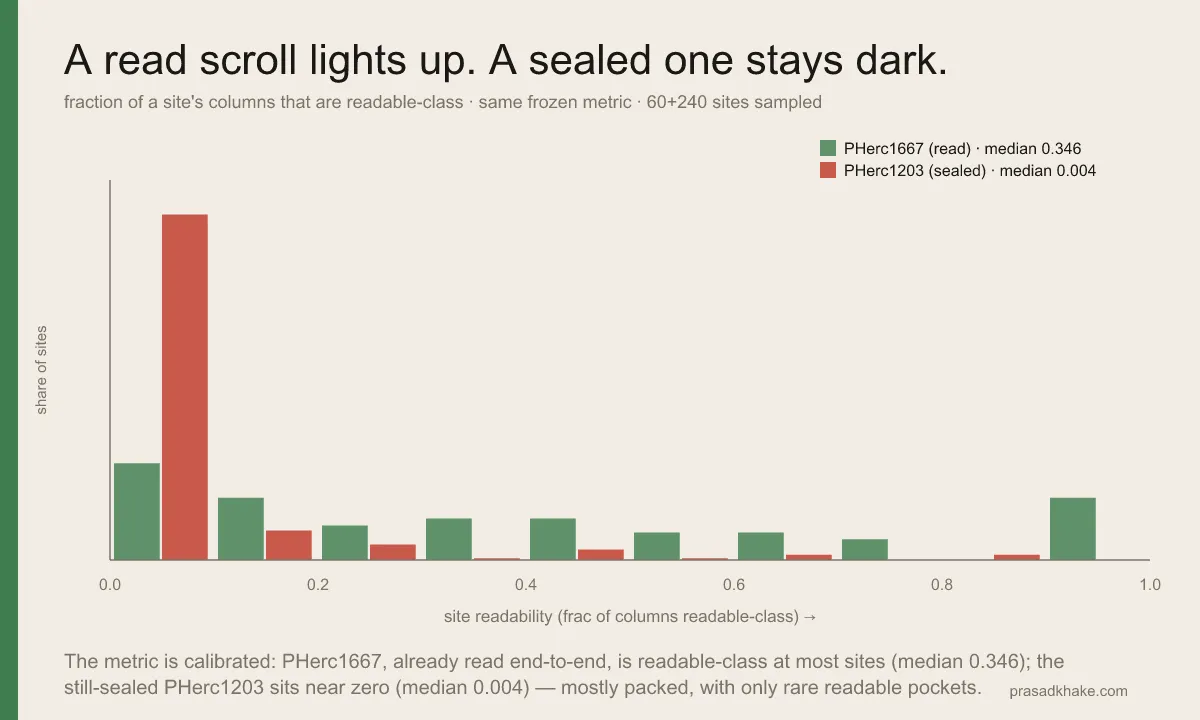
The load-bearing calibration. Known-readable PHerc1667 samples score much higher under this local geometry heuristic (median 0.35) than the stratified PHerc1203 samples (median 0.004). The ~90× median gap shows that the score is not arbitrary, but the later torn-fragment result shows why it is a ranking cue rather than a pre-segmentation acceptance test by itself.
This result says the metric is not just producing arbitrary scores. On known-readable PHerc1667 samples, the same procedure finds many locally readable-class windows. On stratified PHerc1203 samples, it mostly finds packed geometry. It is useful for measuring local separability, but it does not establish that a high-scoring location belongs to a coherent sheet.
The PHerc1203 survey was mostly negative, but not entirely. Most sampled locations scored near zero,
with a median frac_readable of 0.004. The maximum site reached 0.89, and 13 of the 240 sites were at
least 0.4. These are rare local cues, not broad regions. Follow-up showed that the top-ranked cues
were torn fragments, so the score cannot prioritize segmentation without a separate coherence test.
The same result is consistent with why the public PHerc1203 surfaces fail. I ran a basin probe around the
22 public auto_grown surfaces, searching within plus or minus 100 voxels along the normal and plus
or minus 24 voxels tangentially. I did not find a readable-class window within those bounded
neighborhoods. The tested surfaces therefore sit in locally packed regions. Their speckle does not,
by itself, establish whether the ink model could work elsewhere on PHerc1203.
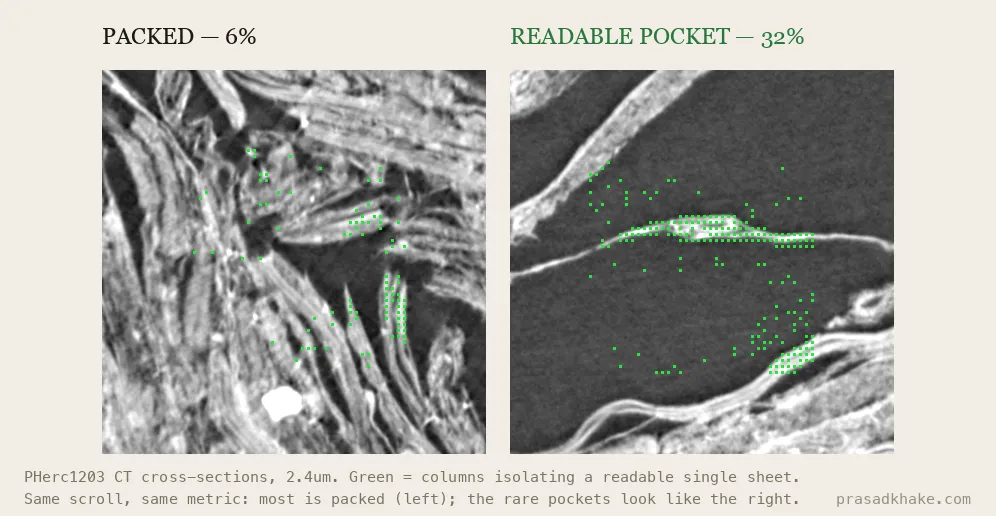
The same scroll, the same metric, two places. Left: packed, crushed material at a low-scoring sampled site. Right: a high-scoring pocket with locally separated bright bands. Later full-resolution inspection showed that the right-hand pocket was torn rather than one coherent sheet.
I had one uncomfortable moment with the best PHerc1203 pocket. Dense mapping initially made it look like the pocket fragmented into tiny pieces. That would have weakened the result, because a few isolated readable columns are less useful than a coherent surface target. I then ran the identical pipeline on a known-readable PHerc1667 site, and it fragmented in the same way. That pointed to my normal estimation as the source of the fragmentation, not the material.
To check this more directly, I ran a small robustness panel with the same 384³ pipeline on three
groups: five readable PHerc1667 anchors, five dead PHerc1203 controls, and the top three PHerc1203
pockets. The readable PHerc1667 anchors had median frac_readable 0.30 and median largest connected
component of 2950 cells. The dead PHerc1203 controls had median frac_readable 0.014 and component
size 25. The top PHerc1203 pockets landed in between, with median frac_readable 0.14 and component
size 573.
The best PHerc1203 pocket was stronger than that median: frac_readable 0.33, largest connected
component 3943. That puts it inside the distribution of the readable PHerc1667 anchors in this panel.
Pockets two and three were intermediate.
I want to be careful about the wording here. The best pocket is comparable to or better than known-readable PHerc1667 anchors under this local pipeline. I am not claiming it is statistically indistinguishable from them. This is one top pocket compared against a small control panel, not a large-powered study. Raw 2.4 µm inspection later showed why that distinction matters: the pocket was a high-scoring torn fragment, not a coherent read target.
The other limit is more basic: this measures readability potential and geometry, not ink. I did not read letters. I did not grow a surface at the pocket. I did not render it through the full reading path. Absolute sheet area is also pipeline-limited. The same pipeline undercounts even on readable PHerc1667, so I report coherence relative to the PHerc1667 anchors rather than treating the raw area as an absolute physical measurement.
Even with those limits, the result changes the next step. Before this survey, a natural approach was to try surfaces, render, run ink detection, and inspect the output. That is expensive, and on PHerc1203 it can burn effort on surfaces that never had a separable 62-layer window to begin with. This CPU diagnostic can reject locally packed regions, but a second test must establish that any high-scoring material continues as a coherent surface.
That fits the challenge’s geometry-first pipeline. If the rendered window does not isolate one sheet, a better ink model is being asked to solve the wrong problem. Local separability should be checked before GPU inference, but it must be paired with sheet coherence.
The code and candidate coordinates are public. The immediate follow-up attempted to grow and inspect the best pockets. They did fail: the highest-scoring locations were torn fragments. That failure sharpened the method. A useful search must require both local separability and continuity across a coherent sheet.